

CL
500
Volume 500 mL
Φ 87 mm
H 113 mm
Baffle width 17 mm

1000
Volume 1 L
Φ 109 mm
H 143 mm
Baffle width 22 mm
2000
Volume 2 L
Φ 139 mm
H 180 mm
Baffle width 28 mm
Recommended Geometric Proportions
for Baffled Beaker Mixing:
Impeller Diameter
Baffled Beaker Diameter
= 0.3 – 0.5
Liquid Height
Baffled Beaker Diameter
= 1
Impeller Clearance
(from bottom)
Baffled Beaker Diameter
= 0.3 – 0.5
Baffled Beaker
Foam-free mixing, with an ergonomic design
The baffled beaker is designed to reduce bubble formation during mechanical stirring. The baffle structure is optimized by CFD (Computational Fluid Dynamics). It suppresses strong vortex caused by impeller-driven radial flow. This minimizes air entrapment and reduces the need for defoaming agents or vacuum degassing. The baffles also break the vortex structures. This promotes chaotic flow and microscale interaction, improving mixing uniformity. Baffled beaker is made of chemically resistant, biocompatible, and shatter-proof material. This ensures safety and compatibility in demanding environments. An optional sliding lid prevents splashing and contamination. It enhances safety and improves yield during operation.
Key Benefits:
-
Non-Vortex Design: suppresses vortex formation to reduce foaming and air entrapment
-
Efficient Mixing: CFD-optimized baffles enhance fluid circulation and usable mixing volume
-
Safe and Lightweight: Durable polymer body — shatterproof and easy to handle
-
Chemical-Resistant PEN: Made from PEN for excellent resistance to solvents, acids, and heat
-
Optional Lid: A dedicated sliding lid compatible with the non-vortex beaker allows impeller mixing while minimizing splashing and contamination
Applications:
-
Viscous liquids: latex emulsions, paints & coatings, creams & lotions, polymer solutions
-
Powder–liquid: pigment dispersion, pharmaceutical, ceramic slurries
-
Degassing-sensitive: cell culture media, specialty chemicals, sensitive to entrapped air
For additional information, feel free to download the technical data or contact us
◄
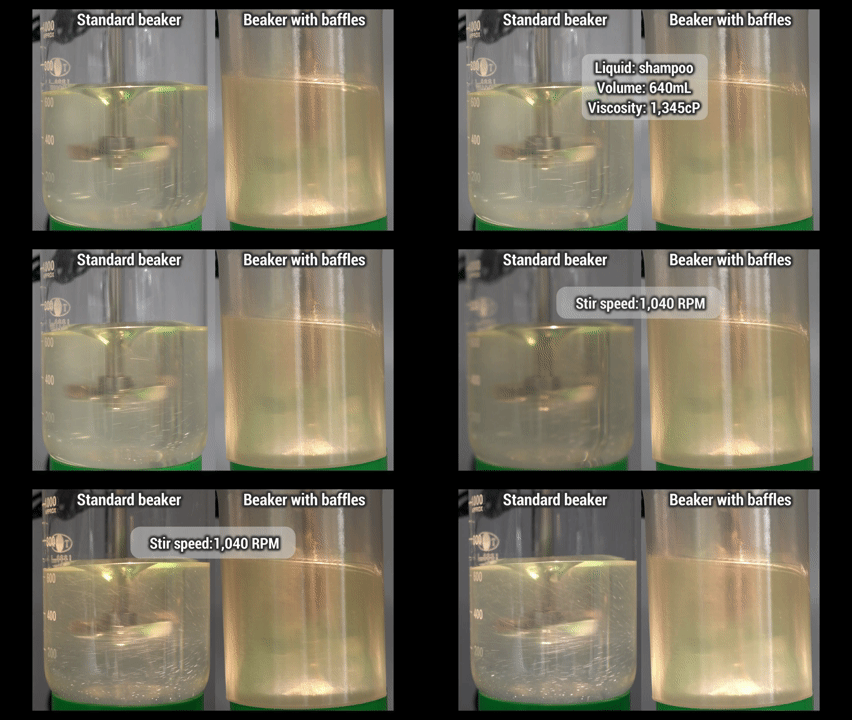
Baffled vs. standard beaker mixing test at 1040 RPM using a pitched blade paddle in 640 mL of 1345 cP shampoo. The standard beaker quickly entraps air, forming bubbles, while the baffled beaker prevents air entrapment. This eliminates the need for defoaming agents or vacuum defoaming, reducing costs and boosting workflow efficiency.
Innovation 1
Biocompatible, Eco-conscious Material — PEN
-
Certified to
USP <88> Class VI, USPP<87>, ISO 10993‑4, and ISO 10993‑10


-
Low Extractable potential and PFAS-free


-
Complies with ADCF, REACH, and RoHS 2

-
Autoclave / Gamma / E‑beam sterilizable

Innovation 2
CFD Simulation-Optimized Design
▲ Vorticity distribution in glass beaker.

Baffled beaker:
Standard beakers generate a strong central vortex, causing all fluid layers to rotate in the same direction. This limits mixing across the volume.
The FLXR CL baffled beaker is designed for efficient, non-vortex mixing. Its baffle structure suppresses vortex formation and increases internal shear.
As a result, vorticity is more evenly distributed, air entrapment is reduced, and mixing becomes more uniform throughout the beaker.
These features make the CL baffled beaker ideal for applications demanding high mixing precision and process reliability.
▲ Vorticity distribution in baffled beaker

▲Flow movement on the XY plane
of a rod stir bar in a baffled beaker
The CL baffled beaker effectively reduces air entrapment during stirring. This minimizes the need for defoaming agents or vacuum degassing equipment, helping users lower material costs and save processing time.
The baffles also disrupt strong vortex formation, converting it into chaotic flow. This promotes more active fluid interaction and improves overall mixing efficiency, especially in complex or high-viscosity formulations.
The beaker features an ergonomic design and is made from a shatter-proof, chemically resistant material, greatly enhancing operational safety and ease of use.
By improving both fluid dynamics and handling safety, the CL baffled beaker supports more consistent and reliable outcomes in demanding environments.
Usage example
This video compares the results of placing a pitched-blade turbine in two distinct beakers: standard and baffled.
The defoaming time of beaker with baffles is 51 minutes less than that of without baffles.
Scientists' workflow can be accelerated with baffle technology.
This video presents a comparison between two types of beakers: a standard beaker and a baffled beaker. The fluid flow between two distinct types of beakers varied significantly under identical conditions. The standard beaker forms a deep vortex and entraps the air into the liquid whereas thebaffled beaker does not.

Explore our channel to learn more.
